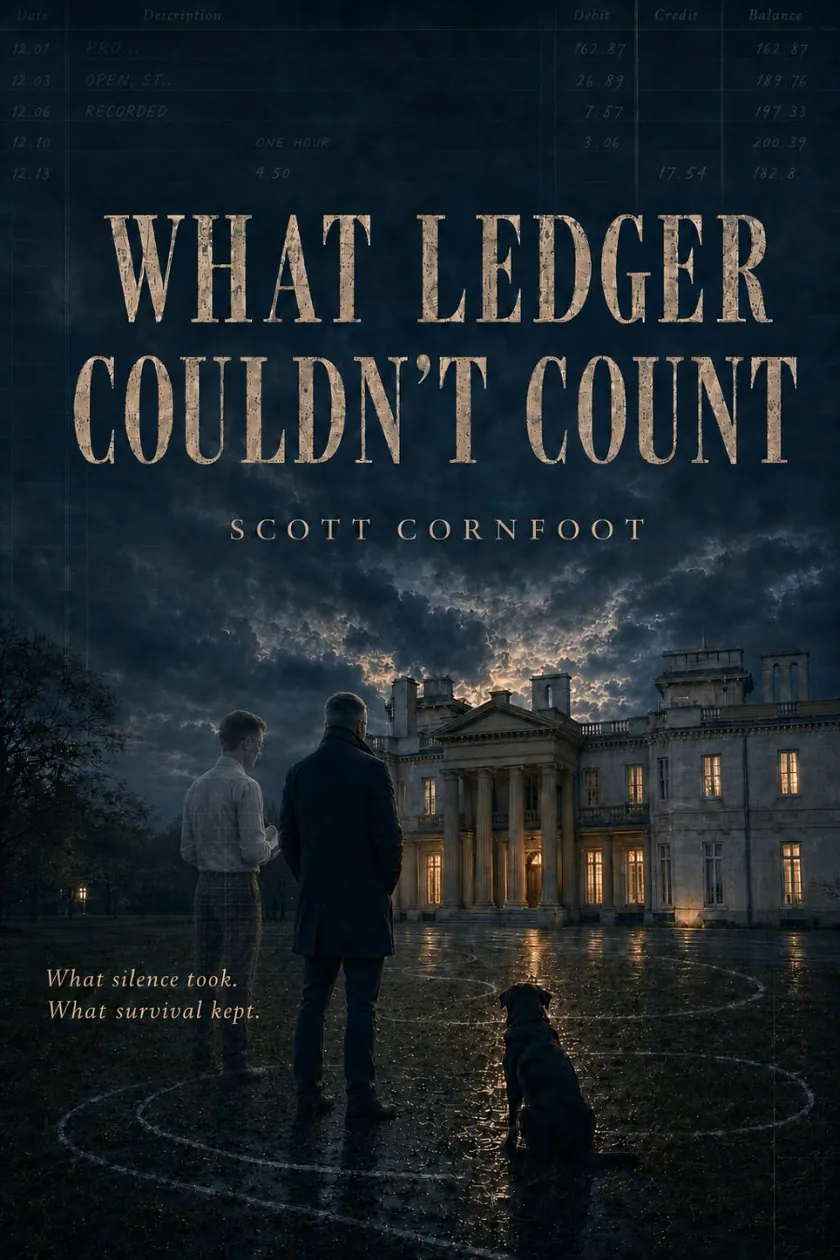
What Ledger
Couldn't Count
Some lives get recorded.
His got counted.
Literary memoir, complete at approximately 56,000 words · Five acts, forty-seven short chapters · Seeking representation · Full manuscript, proposal, synopsis, and chapter outline available on request
What Ledger Couldn't Count contains descriptions of coercive control, grooming, psychological abuse, disordered eating, body shaming, grief, and medical assistance in dying. The material is presented with restraint, but some scenes may be difficult for readers with related experiences.
He arrived as a teenager and left as a young adult, under one of the most powerful coaches in Canadian figure skating. The system kept perfect records of everything except what it cost him.
Scott Cornfoot came to the rink as a teenager with talent, a work ethic, and a place on the ice that hundreds of skaters wanted. He stayed seven years. High school, a university degree, five trips to the Canadian National Championships. He left as competitive skating ended and the touring years began. On paper it looks like a career that worked.
The paper is wrong about the price. Practice hours, weigh-ins, placements, and clean landings were all counted precisely. What they cost went into a ledger nobody else was keeping.
This is an account of surviving a system built around one man's authority, of the adults who watched and said nothing, and of the decades it took to say so out loud. It moves from the ice to a Grade 2 classroom in Ontario, from a stopwatch pressed against a young skater's ribs to a garage where a man in his forties strips old furniture back to the grain and finds the wood has kept every mark. Scott was one of many skaters in that building. He is one of the few putting it on paper.
It is also about hypervigilance, and what happens to someone trained to measure his own worth when he tries to build a life that will not reduce to a score. Competence can be a symptom. Doing fine can be the injury still running.
The training landed on a brain that was still under construction. It held. It is still holding.
A record, finally kept by one of the people it happened to. There are others.
Read the full overview
As a teenager I competed in pairs at the national level under one of the most decorated coaches in Canadian figure skating. The training produced champions. It also produced children who were weighed, timed and ranked, and who learned to read an adult's face before they trusted their own bodies.
The cruelty was not constant, which was most of its power. A public shaming could be followed by a hug. The same man who made me feel inadequate was the father figure whose approval I wanted with everything I had. I belonged to something important, and somewhere in there I lost the joy. I think it left when I realized I had no control over anything anymore. I didn't tell my parents. None of us told our parents.
To survive it I invented a guardian angel and made him an accountant, because an accountant keeps things balanced. I called him Ledger.
Ledger stayed thirty years.
He counts everything and justifies everything. He turns praise into a debt that gets called in later. What began as a boy's private accounting system followed me into adulthood and audited a marriage, a mortgage, a classroom of eight year olds, my father's death, and every ordinary day in which some part of me is still at the boards waiting to be judged.
It followed me into coaching, which was my gift. My skaters reached nationals and junior worlds. They stood on podiums. Some became Canadian champions. I recorded every one of those results as an accident that had nothing to do with me. It was not an accident. I was a good coach, and I never found out how good I might have become, because I was still that boy at the boards. I left the sport when I stopped trusting my own authority.
I miss it still.
I'm a teacher now, standing where my coach once stood, holding the same power over how a child understands a mistake. Whether that cycle can be broken is the question the book keeps putting to me in small moments rather than large ones. I leave a crooked stripe uncorrected. I believe a child who says something hurts. The answer gets worked out in classrooms, not in conclusions.
What Ledger Couldn't Count is also an attempt to restore an erased record. Skate Canada inducted my former coach into its Hall of Fame with a public announcement. Years later it removed him without explanation and his biography page disappeared. Elsewhere he is still described as a consummate coach. In 2023, Lanni Marchant testified before a House of Commons committee about the system we came up in. She was one of the younger skaters at the centre in my last seasons there, and she went on to the Olympics and the Canadian marathon record. A ledger records what an institution decided to count. This book is the account of what the official one left out, and the cost in it was never only mine. It is carried by hundreds of kids who are adults now, scattered across the world.
The book is angrier than I expected and funnier than its subject would suggest. The comedy is survival equipment: dressing room jokes, queer friendship, dogs with no respect for despair. Laughter is the one thing Ledger cannot file.
The book closes with an afterword I did not write. Jen Edwards came up at the same centre, starting out as my amateur career was ending, on the same ice under the same man. In 2023 she published her own account of it, and reading it I found my life in someone else's sentences: the posted weights, the code of silence, the things we all knew and none of us said. Her essay runs here under her own name, with her permission and her final edit.
There is no cure at the end. Recovery is slow, ordinary and unfinished on purpose, repair that leaves the damage visible and calls the piece done anyway. Ledger is not defeated, because he was never the villain. He was a boy's best available solution to a situation no child should have had to solve. What remains is the question of what I owe a survival system once the survival is over.
Who is Ledger?
Two teenage boys are sitting on a dressing room bench after practice, hands shaking, deciding they need guardian angels to survive their coach. One picks Madonna. The other — asked to name something that could actually hold the line — picks an accountant.
“An accountant keeps things balanced.” His name is Ledger. Pressed suit, narrow tie, a book under one arm, never missed a filing deadline. He shows up for the next thirty years: in the back seat at a highway rest stop, in a Grade 2 classroom when a memo goes around about keeping a paper trail.
Ledger counts everything. Hours, placements, percentages, prize money. This book is the account of what he could not.
Ledger is not defeated, because he was never the villain. He was a child's brilliant solution to an impossible situation, and the question the book finally asks is what a survival system deserves once the survival is over.
It is also, frequently, very funny
A choreographer with a ghetto blaster on her shoulder, telling a teenage skater his arm has committed a crime. A drywall sheet coming off a bathroom ceiling onto two men who had just high-fived. A broken mug, a dog, and a man on his kitchen floor laughing hard enough to end an argument he has been losing for thirty years.
Five acts, forty-seven chapters
Plus a prologue and an author's note.
Anchor
Prologue and Chapters 1–14A boy learns to skate in a rink where adults look away, and finds one coach who refuses to. Grace gets him as far as she can, then hands him to Kerry Leitch's national training centre in Cambridge, where the work is measured by a stopwatch and the children are measured by calipers. Present-day chapters run alongside it, in a Grade 2 classroom where an adult holds the room a different way. He is also learning what a rink does with a boy like him. Chapter one hands him the word before he has any use for it, and it is a long time before he meets people who use it differently. Act One is the record of how a teenager with talent and no protection learns to trade himself for approval. Survival takes a choreographer's corner and a best friend. It also takes an imaginary accountant, hired to keep the books. His name is Ledger.
Where the Grain Still Remembers
Chapters 15–26The tour comes first, and the friend who got him through the rink comes with it. People tell him he is rare, and none of it gets past the accounting. Then the adult life begins without the one person who knew what he had survived, and the discipline that carried him through the rink turns out to be no help at all outside it. What he loses in these chapters he loses in order, and Ledger keeps the running total. Relief arrives too, though never where he goes looking for it. He finds it in stripped furniture, in his father's trumpet played without a trumpet, and in a laugh loud enough to break a column. The act ends where he works now, in front of twenty-two seven-year-olds, with a wet blue stripe he decides not to correct.
Learning to Remain
Chapters 27–34A box of skating things waits in his mother's garage. It takes three days and three moves before he sits down on the concrete at midnight and opens the lid. A parent writes that his classroom feels safe, and Ledger lowers his pen without writing anything down. The rink, when he drives back to it, has been rebuilt past recognition, and he cannot find the door he spent years learning to fear. Then illness arrives in the family and takes the year apart, and everything he has been putting off stops being optional. Act Three is the slow work of learning to remain in a life he had only ever learned to survive. It ends with a click on a screen, late at night, that he does not yet know is the beginning of something.
Going on Record
Chapters 35–43Years earlier, one adult stepped onto the ice in ballet slippers and said out loud what everyone else had agreed to survive around. She was gone from the schedule the following week. The click becomes a thread, and the thread becomes nineteen former skaters discovering that none of them had been alone in what they carried. He opens a new document and types a title, Statement for the Record. The record turns out to be the contested ground. The page announcing Leitch's Hall of Fame induction has quietly vanished, with nothing posted to mark the removal, while testimony from the same rink is read into the record of a House of Commons committee. Then the ledger turns on him, and the standard he has been holding an institution to gets applied to a season of his own coaching. Putting your name beside what happened to you is one kind of work. Putting it beside what you did is another.
Return
Chapters 44–47, an Author's Note, and Jen Edwards's essayHe tells the whole story of the award at last, the one the coach turned into a joke with a microphone in his hand, and decides he needs proof that the ice is no longer the coach's. The proof arrives on a night nobody is trying to make respectable, in a room where he counts nothing. Grace is still teaching children that falling is not a verdict, and she tells him to keep what is his this time. Even Ledger attempts a ledger of joy, and reports that joy resists columns. The act ends at the moment this book became possible. The last word belongs to Jen Edwards, whose account carries what his cannot.
The rink ran on two clocks
One hung where everyone could see it. The other ran in a room at the end of the hall.
The visible clock
Clock One is the visible clock: the scoreboard, the stopwatch, the whistle. It measures the body, in laps and run-throughs, stitches and swelling. Everything it demands is public, countable, and at least nameable. The coach can be cruel here too, at the boards in front of the whole session, or on lit ice at the spring ice show, microphone in hand, presenting an award the lighting crew had voted for and then telling the crowd to give it up instead for the other boy. But you can point at Clock One. You can say that was hard, and everyone who was in the building knows what you mean.
Clock One punishes effort, and the body absorbs it. There is even humour at the boards.
Dressing Room 6
Clock Two is Dressing Room 6, the hidden clock. It measures worth instead of time, runs on the coach's schedule rather than the rink's, and has no witnesses. Nobody changes in Six. It sits at the quiet end of the hall precisely so that whatever happens there leaves no mark anyone can see.
Clock Two punishes identity. It draws no blood, and it does the deeper damage.
A stopwatch resets to zero between run-throughs. The second clock never resets, which is why, decades later, a trace of the same cologne in a school hallway is enough to close a teacher's hand around the edge of his desk.
Prologue: Proof
I cannot stand still. My partner and I are waiting to take the ice at the Canadian Figure Skating Championships. It is our first season competing in the junior pair event. I am still in love with the sport. The lights are so bright they flatten depth. The noise from the crowd presses against my skin. Hunger holds its place underneath.
I pace the space behind the boards and check the same lace twice. I visualize each element of the program, even though my body knows how to do them without my involvement. My partner stands beside me. Her eyes are steady. Mine keep moving. She taps her blade once against mine, on purpose. We have learned to send messages beneath the noise. I look to her. She takes my hands and helps me match my breath to hers. I settle.
Our coach calls; we turn to him. He adjusts my collar, then hers. His fingers are cold and clinical against the fabric. Every touch carries the same warning: Do not make me regret choosing you.
The gate swings wide, and the building inhales. The ice tilts white beneath the lights. The crowd falls away. We skate to centre ice hand in hand, our fingers tightening before we let go to circle into our starting position, until my breathing becomes the only sound I can hear.
For that moment, nothing moves. Then the music begins, and we skate.
That night, everything holds. The split twist sends her floating above my head, where she rotates twice before dropping cleanly into my catch. I carry her with one hand the length of the rink, her body locked overhead in complete alignment. We have practised the lift until the effort no longer shows, and the dismount draws a roar from the crowd. The death spiral carves its arc as her hair nearly kisses the ice. We hit the final pose, eyes locked.
Chest heaving, air burning cold in my throat, I absorb the noise. The arena feels louder than it should, a collective roar that travels straight up through my blades and into my legs as my chest opens to something unfamiliar. Her hand finds mine again, and as we turn toward the boards, the warmth in my chest continues to grow. I believe our skate was enough. It was better than we should have skated, better than we had been capable of.
Then, I see him waiting.
As we glide toward the boards, I study his expression. His mouth is set in a thin, straight line beneath a familiar scowl. I cannot read his face. The stopwatch rests against his chest. I look down at my skates.
We step through the gate. Another coach hands us our guards. Shame settles in immediately. I force my eyes back up to his: my mind replays the skate for errors I must have made.
He is silent for longer than feels comfortable. He pulls me into a full hug. It is unexpected. The stopwatch knocks once against my ribs, cold through the costume, and the scent of Joop fills the space beside my face.
“Good,” he says near my ear. “We were so good.”
I lock my knees to keep them from buckling. He pulls my partner in to join the moment. The scores appear, and the arena reacts around us. I remain inside that single word, the metal still cold against my ribs.
I remember the stopwatch more clearly than I remember the scores. Only a handful of things feed my hunger. The crowd. The tap of my partner's blade against mine. The hug. That single word. I file each piece away in a drawer labelled Proof.
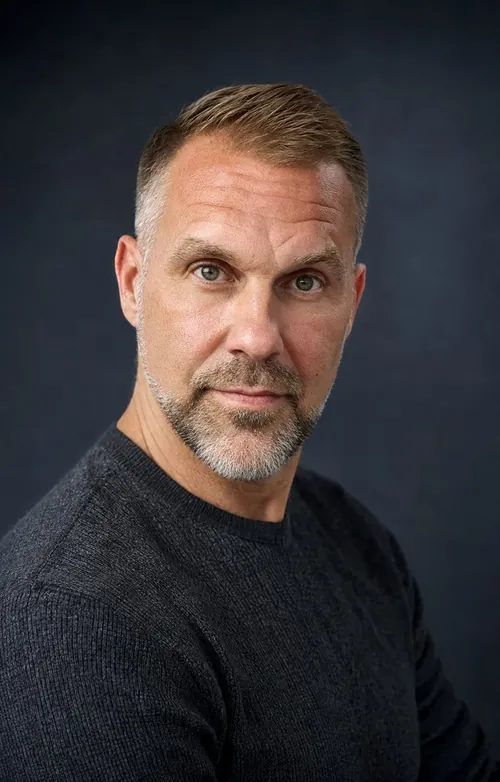
Scott Cornfoot
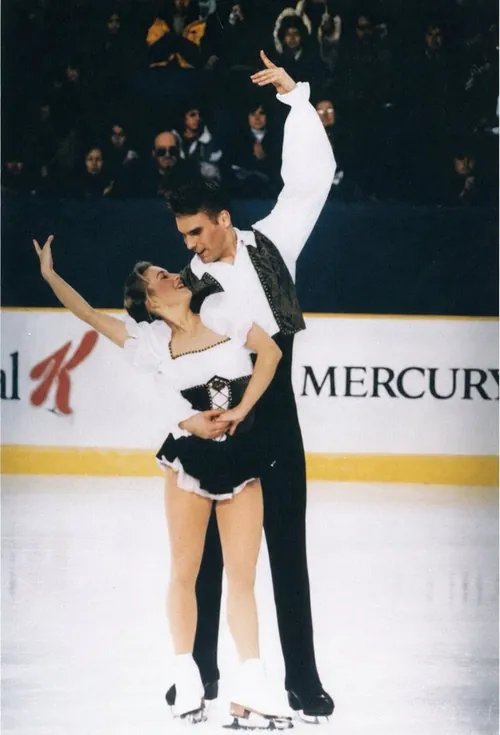
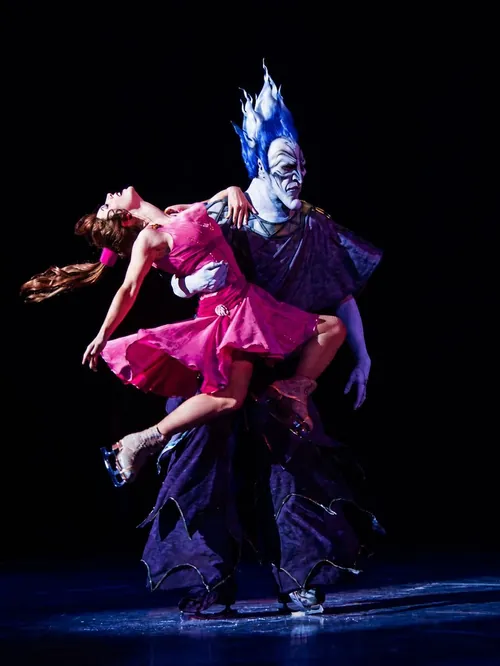
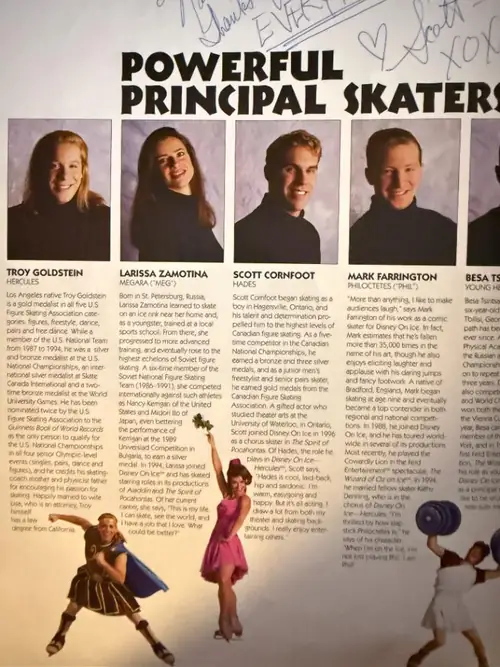
Scott Cornfoot competed for Canada in pair figure skating and toured internationally as a principal skater, including as Hades in Disney On Ice's Hercules.
He teaches Grade 2 in Ontario, almost twenty years in. He writes children's books. He strips and refinishes furniture in his garage. What Ledger Couldn't Count is his first book for adults, and the first time he has told this story under his own name.

The list went up in the public hallway
Every month the skaters lined up at the boards in training clothes. The coach worked down the line with calipers, pinching the skin above the hip, behind the arm, below the shoulder blade, reading each number out loud. The line heard it. So did the parents behind the glass.
The results were typed into a column of names with a percentage beside each one. One copy was pinned to the bulletin board in the public hallway. The same page went out in the monthly club newsletter, on club letterhead, beside run-through scores and test results — home to the kitchen tables of every family in the club.
Beside the percentages, in his own handwriting, he added what he thought each number said about the skater carrying it.
What the record keeps, and what it quietly stops keeping
Inducted, Cambridge Sports Hall of Fame
Listed as a builder. As of August 2026, the biography is still live elsewhere: the athletes who reached Worlds and the Olympics, two decades in which no Canadian club produced more national champions, a “consummate coach” quoted on the twinkle in a young athlete's eye. It mentions none of the rest.
Inducted, Skate Canada Hall of Fame
Named and inducted in 2012, announced with a press release. Twenty-three Canadian champions to his name. The gala followed in 2014, and a video of the ceremony went up on Skate Canada's own channel.
Removed, quietly
Skate Canada took him out of its Hall of Fame following a Safe Sport complaint, then declined a request to tell anyone. “It is not currently Skate Canada's practice to issue a press release when there is a change in status for an individual in the Hall of Fame.” The page celebrating his career was simply deleted.
The page returns nothing
No biography, no photograph, no ceremony video, no record of a removal. One institution erased him. Another still has him up. Neither told the skaters anything.
A book called What Ledger Couldn't Count did not have to reach for its thesis. The sport kept the achievements and deleted the rest — which is precisely what it did to the people inside it.
None of this is metaphor
The book renders in scenes what developmental science documents in studies. Context, not diagnosis.
Toxic stress
When a child's stress response is activated strongly and often, and no supportive adult steps in to buffer it, researchers call the result toxic stress: a prolonged flood of stress hormones that disrupts the architecture of the developing brain and affects learning, behaviour and health for decades. The defining variable is not the hardship itself. It is the absence of a protective adult.
In the book: a rink where the adults watched from behind the glass, and a boy who learned to swallow the sound of his own crying.
Center on the Developing Child, Harvard UniversityEmotionally abusive coaching
Research on elite athletes, much of it Canadian, documents how emotionally abusive coaching becomes normalized inside high-performance training, mistaken for rigour by athletes, parents and clubs alike. Athletes report effects on self-esteem, mood, body image and eating that continue long after retirement, and describe recognizing the abuse as abuse only years later.
In the book: a list of body-fat percentages pinned in a public hallway and mailed home on club letterhead.
Stirling & Kerr, International Journal of Sport and Exercise PsychologyAdverse childhood experiences
Decades of research on adverse childhood experiences links chronic adversity in youth to physical and mental health outcomes that surface far into adulthood. The threat-detection pathways paved in adolescence stay paved. A nervous system trained to scan for danger keeps scanning long after the danger is gone.
In the book: a trace of cologne in a school hallway, thirty years on, closing a teacher's hand around the edge of his desk.
Centers for Disease Control and Prevention, Adverse Childhood ExperiencesWhat sport now admits
The International Olympic Committee's consensus statement names harassment and abuse in sport as non-accidental violence, documents its severe and lasting consequences, and places the duty to safeguard athletes squarely on institutions. The research base is extensive and public. What remains contested is whether institutions act on it, and say so out loud when they do.
In the book: a Hall of Fame page that vanished without an announcement.
IOC Consensus Statement: Harassment and Abuse in SportReaders familiar with the trauma literature may recognize patterns in these scenes: compartmentalization in a boy inventing an accountant to hold what he could not, somatic grounding in a thumb pressed into an ankle after a fall, appeasement in a newspaper folded so a coach's name faced the table. The memoir does not diagnose its narrator. It renders the experience as it was lived, and lets the research say what the research says.
The research may also explain the book's texture. Studies of traumatic memory describe experience returning as sensory fragments rather than narrative, which is how memory arrives in these pages: a cologne, the knock of a stopwatch, cold metal and wet wool. And the confusing loyalty the book describes, fear of a man alternating with hunger for his approval, is consistent with what behavioural research calls intermittent reinforcement. The rink was not only frightening. It was also, for a child inside that pattern, nearly impossible to stop caring about.
This is not one person's account
“I grew up a figure skater. I skated at the Champions Training Centre out of Cambridge, Ontario.”
“It was normalized to be yelled at to the point of tears, and heaven forbid you get pulled into dressing room number six.”
Marchant trained at the same centre, under the same coach, in the same years. She describes weekly weigh-ins with results posted publicly, monthly fat testing, shared dressing rooms with much older skaters, and a culture she calls overly sexed. Dressing Room Six is chapter forty of this book. Neither of us knew the other was writing it down.
She is not the only one. Nineteen former skaters from the same club now sit in one thread, comparing what they each thought was theirs alone: the weigh-ins, the parking-lot laps, the list on the wall, the cologne that arrived before he did.
“We thought you were okay.”“We hoped you weren't hurting like we were.”“We were wrong.”
Before You Sign Up

The memoir is about what nobody in the building knew to ask. This is the short, practical version of what I wish they had been handed: what to ask a coach, what a healthy training room actually looks like, and what to watch for in your own child afterwards.
- Twelve questions for the coach and the club, with what a good answer sounds like
- The warning signs that arrive dressed as high standards
- What changes in a child long before they ever say anything
- What to do, in order, if something is wrong, with current Canadian reporting numbers
- A one-page checklist to photograph and take to the rink
Know when there is news.
No newsletter, no schedule, no marketing. Two or three emails a year at most, when there is something real to report: representation, a publication date, a place to buy the book. Your address is never shared or sold.
The manuscript is complete
Agents and editors: the full manuscript, synopsis, and chapter outline are available on request. Scott is represented by no one at present and handles all inquiries directly.